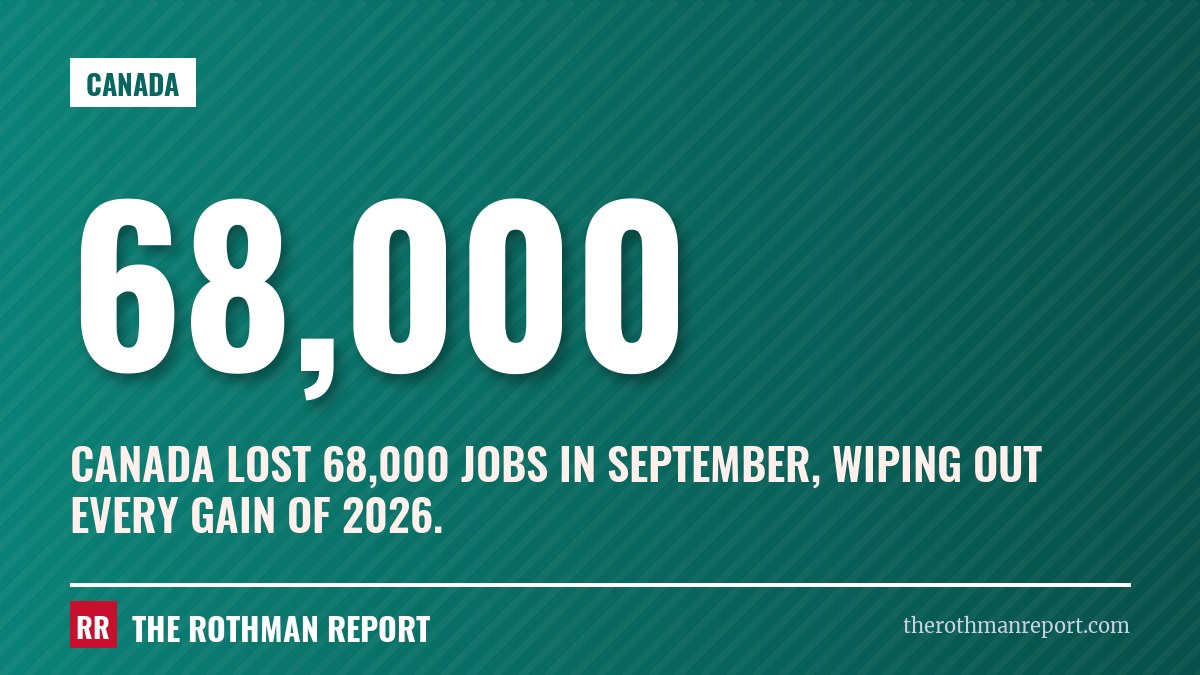

Canada’s economy lost 68,000 jobs in September, Statistics Canada reported on October 9, 2026, and the unemployment rate rose to 6.5 percent from 6.4 percent in August. Economists polled by Reuters had expected the country to add about 9,200 jobs.
It was the second straight monthly decline. August cost Canada about 42,000 jobs, and according to Reuters, the two months together have erased every employment gain Canada recorded earlier in 2026. Year to date, the country is down a net 41,200 jobs, compared with a gain of 211,300 over the same stretch of 2025.
Where the jobs went
The details in Statistics Canada’s Labour Force Survey are not flattering to Ottawa. Full-time employment fell by 35,000 and part-time work by 33,000. The employment rate slid to 60.6 percent, its second monthly decline in a row. Labor force participation fell to 64.8 percent, which the agency says is the lowest since December 1997 outside of the pandemic year of 2020.
- Public sector: employment fell by 70,000, the fourth consecutive monthly decline.
- Education: educational services lost 35,000 jobs and is down 67,000 from a year earlier.
- Health care and social assistance: down 23,000, the sector’s first monthly drop since December 2022.
- Manufacturing: down about 13,000, after gaining 22,000 in August.
- Young workers: employment among Canadians aged 15 to 24 fell by 48,000, roughly seven of every ten jobs lost nationwide, and is down 67,000 over two months.
Quebec took the worst hit, losing 49,000 jobs. Ontario and British Columbia each lost about 20,000, and Ontario’s unemployment rate stands at 7.0 percent. Alberta was the bright spot, adding 23,000 jobs.
A self-inflicted public-sector slide
Reuters reported that the heaviest losses were in the public sector, particularly health care, social assistance and education, and tied that to the federal government’s cuts to international student permits. In other words, a large share of this damage traces back to policy choices made in Ottawa, not in Washington. (Reuters also noted that the falling participation rate reflects an aging population and slower immigration.)
That matters, because Prime Minister Mark Carney has spent months casting Canada’s economic troubles as something done to his country from abroad. The September numbers point instead to a federal government whose own decisions are helping shrink the workforce, while the private sector, which Statistics Canada says was little changed on the month, treads water.
The trade fight Carney walked away from
The report also landed in the middle of a trade standoff Carney chose to escalate. On August 21, 2026, days after President Trump had paused planned duties and announced that the two countries had reached a deal pending final documentation, Carney suspended negotiations and called Canada’s negotiators home. His office said last-minute changes to the U.S. terms were “unfair, uneconomic” and called into question the reliability of any deal.
Washington tells it differently. U.S. Trade Representative Jamieson Greer said Canada “declined to finalize the trade deal under the terms agreed earlier this week,” and that its “new demands and walk backs” upended the balance the two sides had reached. Greer said the U.S. had offered significant tariff reductions on steel, aluminum, autos and lumber, and called the collapse “a missed opportunity” for Canada.
Trump’s 50 percent tariff on what Ottawa put at roughly $28 billion in Canadian goods took effect on August 22. Carney answered with dollar-for-dollar counter-tariffs beginning September 8, targeting American steel, dairy, appliances, agriculture and electronics, and told reporters, “You’re at war when you get attacked. We got attacked.”
Trump did not blink. On August 24, he announced on Truth Social that tariffs on Canadian cars and trucks, auto parts and steel would rise to 50 percent starting January 1, 2027. “Build in the U.S. and there are ZERO TARIFFS,” he wrote. “They feel entitled, and yet, WE DON’T NEED CANADA, THEY NEED US!”
What the numbers do and don’t say
To be fair to the data, economists quoted by Reuters said the latest U.S. tariffs are unlikely to have a major impact on employment figures in the coming months, and September was only the first full month after the new duties took effect. Manufacturing, the sector most exposed to tariffs, lost about 12,700 jobs, a real hit but not the bulk of the decline.
That is not much of a defense for Carney. It means Canada is losing jobs on its own before the full weight of a trade war he declined to settle has even arrived. According to wire reporting on the talks, the deal that collapsed in August would have cut the top U.S. tariff on Canadian cars and light trucks from 25 percent to 15 percent and halved steel and aluminum tariffs from 50 percent to 25 percent. Canadian autoworkers now face 50 percent in January instead.
Markets noticed. The Canadian dollar fell after the release, and money markets dropped expectations of a Bank of Canada rate hike this month. Royce Mendes of Desjardins said Canadian central bankers “will likely need to keep rates unchanged later this month.”
Canada’s next jobs report is due November 6, 2026. Carney has until then to explain why his country is shedding jobs in the sectors hit hardest by his own government’s student-permit cuts, and why walking away from the table was supposed to make it better.
Carney picked the fight, his own policies helped shrink the payrolls, and Canadian workers are the ones paying the tab.
Sources
- Statistics Canada: The Daily, Labour Force Survey, September 2026 (Oct. 9, 2026)
- CP24 / Reuters: Canada's 2026 job gains have been erased. The hardest-hit area wasn't the one facing U.S. tariffs (Oct. 9, 2026)
- CP24: PM Carney says Canada intends to match U.S. tariffs dollar for dollar after suspending trade negotiations (Aug. 21, 2026)
- Fox Business: US-Canada trade negotiations suspended, Carney vows dollar-for-dollar retaliation against Trump's 50% tariffs (Aug. 21, 2026)
- KSL: Trump threatens 50% tariffs on all cars and trucks amid Canada trade spat (Aug. 24, 2026)
- The Standard: Trump threatens 50% tariffs on all cars and trucks from Canada amid trade fight (Aug. 25, 2026)
More from The Rothman Report
 Paralympian Veteran Waited 5 Years for a Wheelchair Lift. She Says Canada Offered Her Assisted Death.
 Glenview Teen Shot Dead at Home: Sheriff Says Evidence Is There, Cook County Still Won’t Charge
 Rhode Island Ruled Him Incompetent for 23 Years and Let Him Walk. Now a Toddler Was Stabbed in Her Stroller.