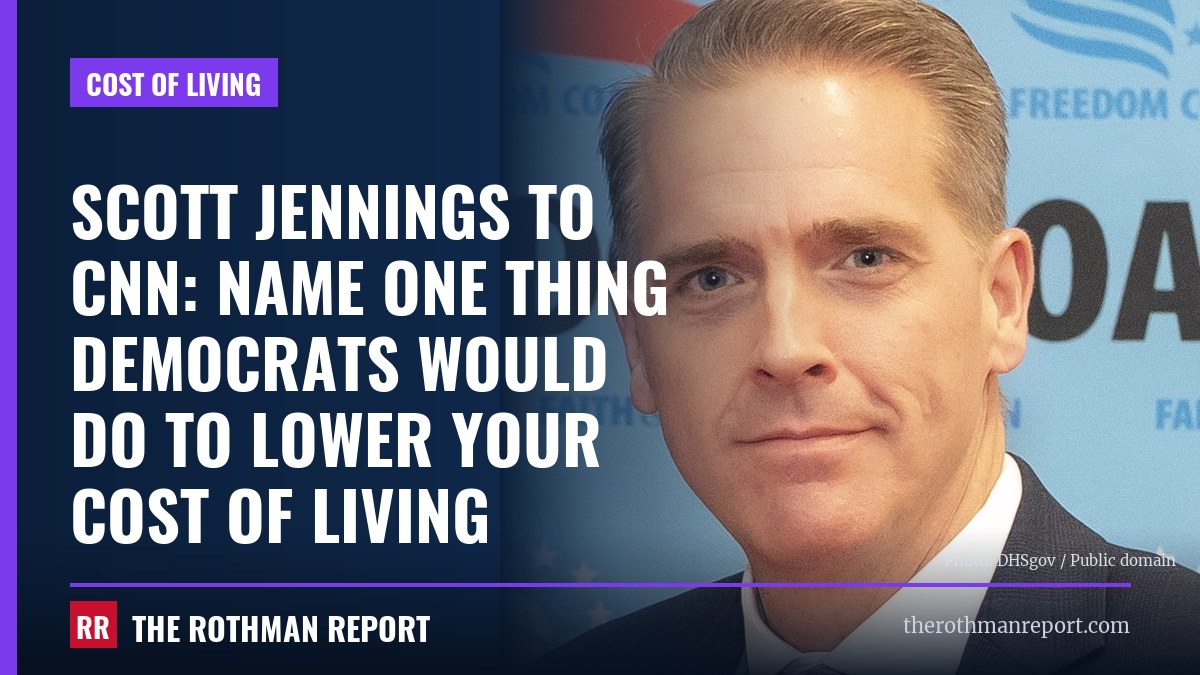

CNN’s on-screen graphic read “Poll: Nearly 80% blame Trump for policies hurting economy.” Scott Jennings, the network’s conservative commentator, did not argue with the frustration behind it. He argued with the conclusion, and asked a question that, in the clip, nobody answers: what, exactly, would Democrats do instead?
The exchange, from a CNN special coverage segment that circulated widely on October 12, 2026, ran barely half a minute. It was one of the most efficient statements of the Republican midterm argument anyone has made on cable this fall.
“What would a Democrat do?”
Jennings opened by granting the premise. “Feel free to be disappointed about one thing or the other,” he said. “What would a Democrat do? Exactly. What has a Democrat proposed to do in this election that would change your life in any meaningful way?”
Then he went after the origin story. “And don’t forget,” he said, “90% of the cost of living that you’re upset with was handed to you by Democrats anyway.”
That figure is Jennings’s own characterization, not a statistic from a government agency, and it should be read as an argument. But the argument rests on something real. The price levels Americans are angry about today were set mostly in the inflation surge that peaked in 2021 and 2022, when Democrats controlled the White House and both chambers of Congress. According to the U.S. Department of Agriculture’s Economic Research Service, grocery prices jumped 11.4% in 2022 alone and another 5.0% in 2023. Prices do not go back down when inflation slows; they simply stop climbing as fast. Families are still paying for those two years every time they check out.
What the USDA data shows
Jennings pointed to that same data for the current picture. “If you look at the USDA data on grocery, they have somewhat tamed food inflation right now,” he said. Then, to his credit, he immediately acknowledged the limits of a chart: “I know a graph is cold comfort to people who are having trouble affording things.”
The numbers back his narrower claim. The Economic Research Service’s September 25, 2026, outlook reported that food-at-home prices in August were 2.2% higher than a year earlier, and that the grocery index was unchanged from July to August. ERS forecasts grocery prices will rise 2.4% for all of 2026, below their 20-year historical average of 2.6%, and projects just 1.8% for 2027. Grocery inflation was 1.2% in 2024 and 2.3% in 2025.
That is a long way from the double-digit spikes of 2022. It is not deflation, and nobody should pretend that a 2% increase feels like relief when, by ERS’s annual figures, grocery prices climbed roughly 21% cumulatively from 2022 through 2025. Some categories, including beef, fresh vegetables and sugar, are still expected to rise faster than average this year, according to RFD-TV’s report on the outlook, while eggs are forecast to fall sharply.
The gas question
Jennings saved his sharpest line for energy. “But the real debate is, what has a Democrat done or proposed to do? Even on gas prices. I hear that a lot,” he said. “When has a Democrat ever proposed a thing to lower gas prices?”
That question matters because voters are, in fact, worried. An Associated Press-NORC poll conducted September 24-28 found that roughly half of Americans are extremely or very concerned about affording gas, and half are very worried about affording food. Those are the voters both parties are fighting for in November.
Democrats are running hard on those anxieties and on blaming the president for them. What is harder to find is a concrete plan to bring prices down. Republicans have long argued that the Democratic energy agenda, built around restricting drilling and pipelines and pushing climate mandates, points toward higher fuel costs, not lower ones. If there is a Democratic proposal to bring down the price at the pump, Jennings was effectively daring them to name it on live television.
Why it lands
The power of the clip is that Jennings did not deny reality. He conceded that people are hurting, conceded that a graph does not pay the bills, and still turned the conversation to the one question that decides elections: compared to what?
Anger is not a platform. A party asking for control of Congress owes voters a description of what it will do differently. If the answer is only that the other side is to blame, voters are entitled to remember who held power when the prices they are angry about were set.
Jennings asked Democrats to name one plan to lower the cost of living, and until they can, the blame on the chyron is a mood, not an agenda.
Sources
- X / @EricLDaugh: Scott Jennings on CNN on Democrats and the cost of living (video, Oct. 12, 2026)
- USDA Economic Research Service: Food Price Outlook, Summary Findings (Sept. 25, 2026)
- RFD-TV: USDA Food Outlook Shows Moderate Inflation, Wide Swings (Sept. 30, 2026)
- FOX 9: Most Americans now blame Trump for high prices, poll finds (AP-NORC, Oct. 1, 2026)
More from The Rothman Report
 Paralympian Veteran Waited 5 Years for a Wheelchair Lift. She Says Canada Offered Her Assisted Death.
 Glenview Teen Shot Dead at Home: Sheriff Says Evidence Is There, Cook County Still Won’t Charge
 Rhode Island Ruled Him Incompetent for 23 Years and Let Him Walk. Now a Toddler Was Stabbed in Her Stroller.