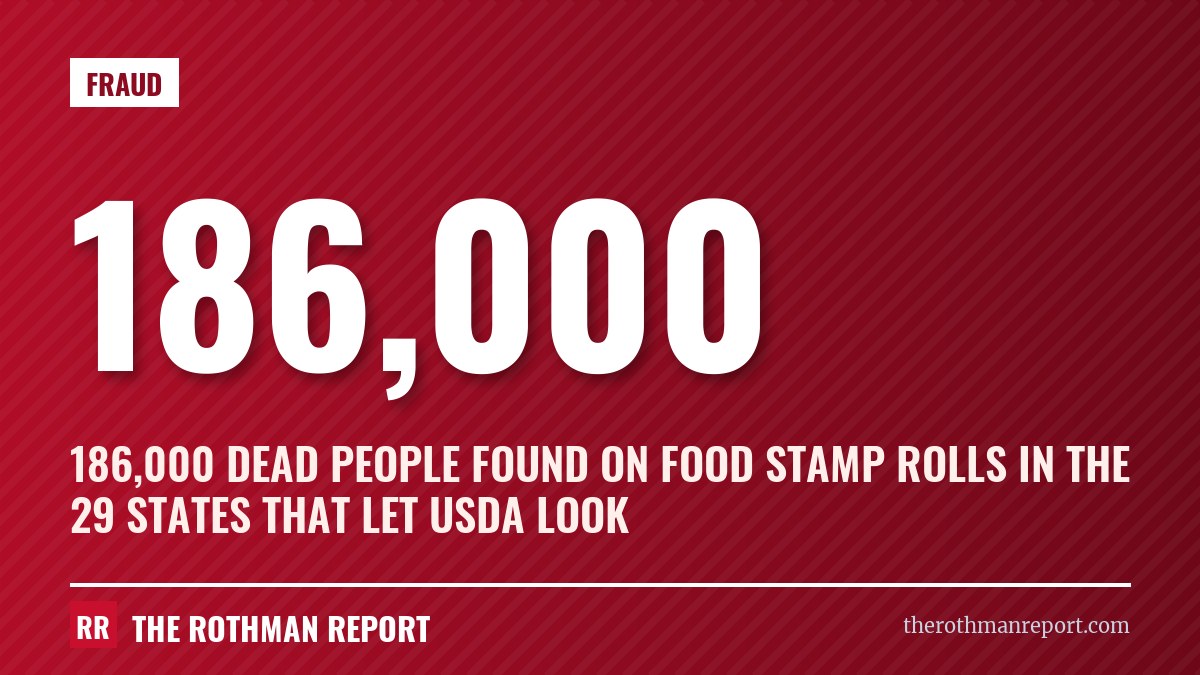

A new report from the Foundation for Government Accountability estimates that fraud against federal programs could be costing taxpayers as much as $521 billion a year, and it points to food stamps as a case study in what happens when states are left to police themselves. In the 29 states that handed their food stamp rolls to the U.S. Department of Agriculture, the report says, federal reviewers found 186,000 dead people still enrolled.
The report, written by FGA senior research fellow Liesel Crocker and published on September 21, 2026, drew fresh attention this week after The Center Square reported on it. Its message to the states that refused to share their data is blunt. “If this much turned up in the states that cooperated, we can only imagine what’s hiding in the states that refuse,” Crocker said.
What the USDA found
The food stamp numbers first surfaced in December 2025. At a cabinet meeting on December 2, Agriculture Secretary Brooke Rollins said data from the 29 states that complied with USDA’s request showed about 186,000 deceased people receiving benefits from the Supplemental Nutrition Assistance Program, along with 356,000 duplicate enrollments, according to Fox Television Stations’ report at the time. The FGA report now puts the number of people receiving benefits in more than one state at once at about 500,000.
That is a staggering result from a partial look. SNAP serves about 42 million people and cost just over $100 billion in the fiscal year that ended September 30, 2024. Every dead enrollee still on the books, and every person enrolled in two states at once, is an account that should have been closed.
The Center Square reported that 21 states refused to cooperate with the federal vetting effort. Crocker pointed to Minnesota as a particular area of concern; according to the FGA report, federal prosecutors estimate fraud cases there could total $9 billion in fraudulent payments. The report also highlighted California, Illinois, Colorado, Maine and New York, which it says federal health officials flagged for suspicious Medicaid and Medicare payments.
Why the holdout states say no
The states that refused have not simply ignored Washington. They went to court. A coalition of 22 states sued, arguing that USDA could share the data, including recipients’ immigration status, with immigration enforcement, which they say would be illegal. U.S. District Judge Maxine Chesney in San Francisco sided with them, blocking the demand in 2025 and, in February 2026, saying in a tentative ruling that the government “cannot act on its letters to the states from last year.” USDA had warned the states in December that it would stop paying state administrative costs for the program if they did not comply.
The administration’s position is that it needs the data to “stamp out fraud and waste,” and that what it has seen shows fraud is higher than previously believed.
That is the real dispute. The holdout states frame it as a fight over privacy and immigration enforcement. But the cooperating states turned over their data and the result was not a privacy scandal. It was 186,000 dead people on the rolls. If the 21 holdouts are confident their programs are clean, the fastest way to prove it would be to let someone check.
The bigger fraud picture
Food stamps are only one piece of the FGA’s case. Crocker said fraud “against federal programs now runs about $521 billion a year, or seven percent of everything Washington spends,” adding that it is “just the fraud we know about.”
One reason it persists is that most programs are barely checked. “Of more than 2,200 federal payment programs, only 64 are reviewed for improper payments each year,” Crocker said. Food stamp trafficking alone, the report estimates, costs between $960 million and $4.7 billion a year. More than 8,000 fraud cases are underway with state attorneys general, which the report calls a small fraction of the total.
“Every dollar that goes to someone abusing the system is a dollar taken from the truly needy,” Crocker said.
What FGA wants done
The report praises President Trump’s war on fraud but says states and Congress have to do more. Among its recommendations: photo IDs on EBT cards, barring liquor stores and smoke shops from the food stamp program, cross-checking enrollment against wage, tax and vital records before benefits are paid, and wider use of Treasury’s Do Not Pay system. For Medicaid, it calls for more frequent eligibility checks and an end to self-attestation.
None of these ideas is exotic. A dead person cannot apply for benefits, and a living person should not be able to collect them in two states at once. Basic verification is not cruelty toward the poor. It is how you make sure the money reaches them.
Twenty-nine states opened their books and found 186,000 dead people collecting food stamps; the states that still refuse to look owe taxpayers an explanation.
Editor’s note: This article covers a Foundation for Government Accountability report published in September 2026 that drew renewed attention in October 2026. The USDA food stamp figures it cites were first disclosed in December 2025.
Sources
- Foundation for Government Accountability: War on Fraud: How Cracking Down on Fraud Will Save Taxpayers Billions (Sept. 21, 2026)
- Just the News (The Center Square): Report: Taxpayers lose $500B annually to fraud as states resist oversight (Oct. 6, 2026)
- FOX 13 Seattle: Trump administration seeking to stop SNAP payments to Democrat-led states for not providing enrollee records (Dec. 2, 2025)
- WCAX (AP): Judge says she'll rule US still cannot force states to provide data on SNAP recipients (Feb. 13, 2026)
More from The Rothman Report
 Paralympian Veteran Waited 5 Years for a Wheelchair Lift. She Says Canada Offered Her Assisted Death.
 Glenview Teen Shot Dead at Home: Sheriff Says Evidence Is There, Cook County Still Won’t Charge
 Rhode Island Ruled Him Incompetent for 23 Years and Let Him Walk. Now a Toddler Was Stabbed in Her Stroller.