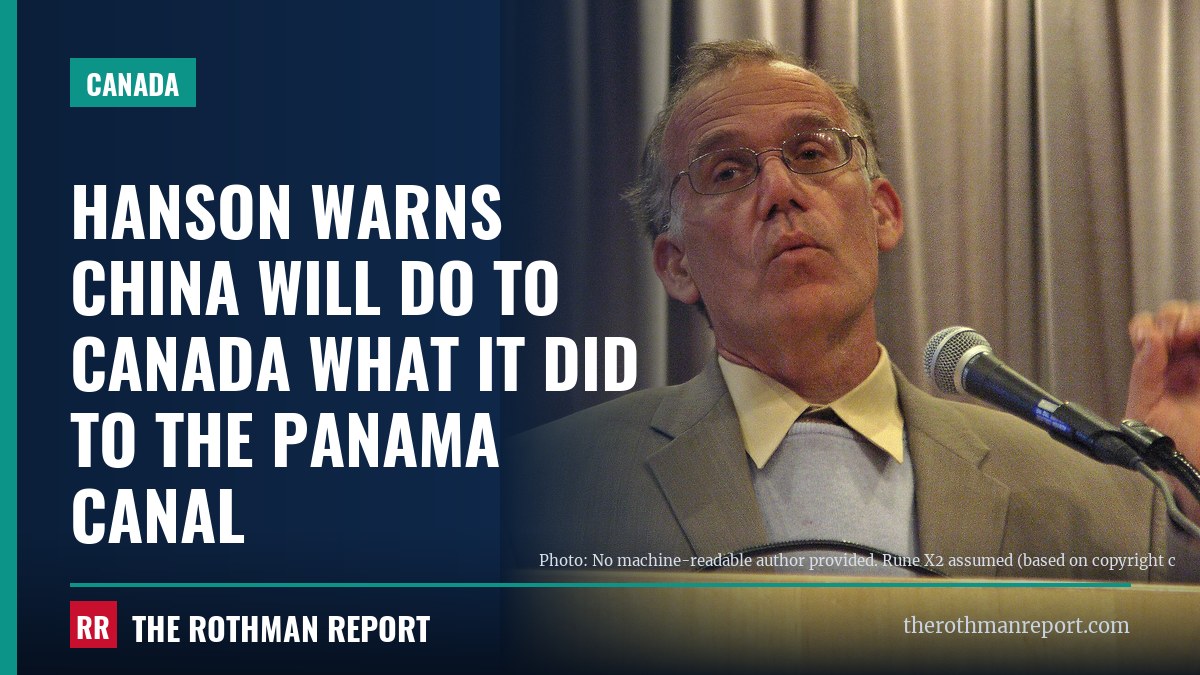

Historian Victor Davis Hanson says Prime Minister Mark Carney is gambling Canada’s most important economic relationship on a fight over a sliver of it, while opening the door to China. In a video posted by The Daily Signal on Oct. 4, 2026, Hanson warned that if Carney gets his way, “the Chinese will try to do to Canada what they did to the Panama Canal.”
It is a blunt warning, and the record behind it is worth laying out, because the pieces Hanson points to are real.
Hanson’s case
Hanson opened with the scale of what Carney is risking. “Carney has a $400 billion trade with the United States, and he’s jeopardizing that over 2% of it that has a tariff,” he said.
The first figure is close to the official count. According to the Office of the U.S. Trade Representative, the United States imported an estimated $381.9 billion in goods from Canada in 2025, out of $715.5 billion in total two-way goods trade, and ran a goods deficit with Canada of $48.3 billion. For Canada, the American market is not one customer among many. It is the customer.
Hanson argued that Carney put that at risk “by deliberately walking out of negotiations,” and then had his ministers, instead of explaining “what happened and why he walked out,” simply “parrot the line.” Carney did suspend talks with Washington on Aug. 21, 2026, saying “last-minute changes in the U.S. proposed terms were unfair, uneconomic, and called into question the reliability of any deal,” and vowed to match U.S. tariffs “dollar for dollar,” Fox Business reported. U.S. Trade Representative Jamieson Greer called it “a missed opportunity for Canada.”
The elephant in the room
Then Hanson got to what he sees as the real story. “But the elephant in the room is that he’s letting in 48,000 cheap EVs with only a 6% tariff,” he said, “and he’s going to destroy the Canadian auto market, but he’s also going to destroy its export to us because he’s allowing cheap materials, especially aluminum and steel, to come in to reassemble as exports.”
The deal he is describing is documented. On Jan. 16, 2026, during a visit to Beijing, Carney agreed to let up to 49,000 Chinese electric vehicles into Canada at a 6.1 percent tariff, replacing the 100 percent surtax Canada imposed in 2024, according to Al Jazeera. In return, China agreed to cut its combined tariff on Canadian canola seed from 84 percent to about 15 percent and to lift tariffs on canola meal, lobsters, crabs and peas.
Carney sold the deal as a reset. “This is a return to levels prior to recent trade frictions, but under an agreement that promises much more for Canadians,” he said, according to Al Jazeera.
Washington’s reaction was immediate. On Jan. 24, President Trump wrote on Truth Social that “Governor Carney” was mistaken if he thought Canada could become a “Drop Off Port” for China to ship goods into the United States, warned that China would “eat Canada alive,” and threatened a “100% Tariff” on Canadian goods if Canada made a deal with Beijing, according to the American Presidency Project’s archive of his posts. Later that day he added, “The last thing the World needs is to have China take over Canada.”
Why Panama
Hanson’s comparison to Panama is pointed. “They will start buying up stuff, Chinese companies,” he said of what he expects in Canada.
In Panama, the concern was never an invasion. It was ownership. Hong Kong-based CK Hutchison ran two ports on the Panama Canal, and early in his second term Trump said the United States should “take back” the ports because of growing Chinese influence. In March 2025, CK Hutchison agreed to sell them, along with dozens of other ports worldwide, to a group led by the American firm BlackRock. Beijing’s response told the world how it saw those assets: a Hong Kong newspaper called the sale “a spineless kneeling, profit-seeking and unrighteous act,” and Chinese authorities reportedly told state-owned businesses to stop dealing with the company, The Telegraph reported.
That is the model Hanson is warning about. Beijing does not need to plant a flag. It needs ports, plants and supply chains, and it is patient about acquiring them.
What it means for America
The American objection to the Carney deal is not about 49,000 cars. It is about what Canada becomes inside a North American market built on free trade with the United States. If Chinese steel, aluminum and components can enter Canada cheaply and then cross the border as “Canadian” goods, every American tariff on China leaks. That is the “drop off port” Trump warned about in January.
Carney calls his strategy diversification. Hanson calls it a bet that America will blink. Either way, the arithmetic is unforgiving: Canada’s access to its largest market is worth hundreds of billions of dollars a year, while the farm and seafood concessions it won from Beijing could unlock nearly $3 billion in export orders, by the estimate Al Jazeera reported.
Canada is trading its best customer for its biggest strategic risk, and Victor Davis Hanson is right that Washington has every reason to say no.
Sources
- The Daily Signal on X: Victor Davis Hanson: China Will Do to Canada What They've Already Done to Panama (Oct. 4, 2026)
- Office of the U.S. Trade Representative: Canada trade summary (2025 data)
- The American Presidency Project: Truth Social Posts of January 24, 2026
- Al Jazeera: Canada, China strike trade deals to slash tariffs on EVs, canola (Jan. 16, 2026)
- Fox Business: US-Canada trade negotiations suspended, Carney vows dollar-for-dollar retaliation against Trump's 50% tariffs (Aug. 22, 2026)
- The Telegraph via Yahoo News: Beijing punishes Hong Kong tycoon for sale of Panama Canal ports to US (March 27, 2025)
More from The Rothman Report
 Paralympian Veteran Waited 5 Years for a Wheelchair Lift. She Says Canada Offered Her Assisted Death.
 Glenview Teen Shot Dead at Home: Sheriff Says Evidence Is There, Cook County Still Won’t Charge
 Rhode Island Ruled Him Incompetent for 23 Years and Let Him Walk. Now a Toddler Was Stabbed in Her Stroller.