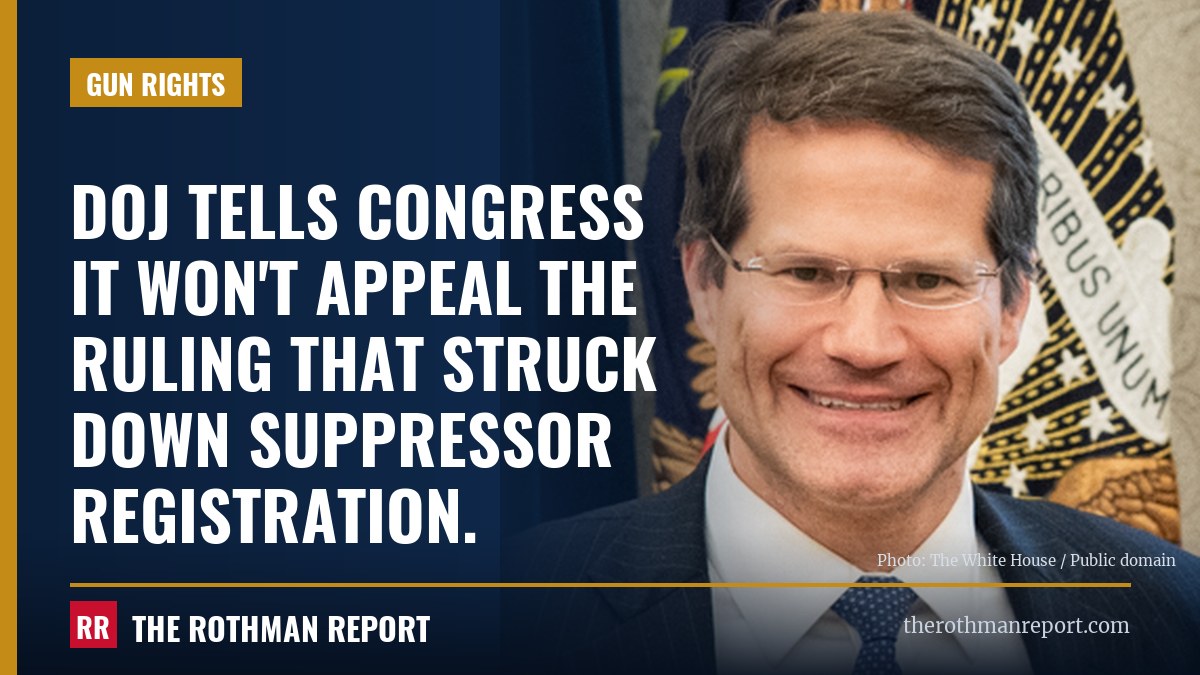

The Justice Department has made it official: it will not appeal the federal ruling that struck down National Firearms Act registration requirements for suppressors, short-barreled rifles and short-barreled shotguns. In a letter to House Speaker Mike Johnson dated September 24, Solicitor General D. John Sauer wrote that “the Department of Justice has determined not to file an appeal” in Silencer Shop Foundation v. ATF.
That letter, which Breitbart News reported on October 2, closes the door on the government’s fight to keep the registry alive for the plaintiffs and their members and customers. The ruling by U.S. District Judge James Wesley Hendrix of the Northern District of Texas now stands.
How a tax cut toppled a registry
The National Firearms Act is nearly a century old. For most of its history it imposed a $200 tax on making or transferring certain firearms, and it wrapped that tax in a web of registration, reporting and recordkeeping rules. In 1937, in Sonzinsky v. United States, the Supreme Court upheld those registration rules as a valid exercise of Congress’s power to tax.
Then the tax went away. As Sauer’s letter recounts, in 2025 Congress passed and President Trump signed the One Big Beautiful Bill Act, which, in the district court’s words, “amended the NFA to eliminate the transfer and making taxes on short-barreled shotguns, short-barreled rifles, silencers, and AOWs.” But, the court noted, “Congress left in place the ‘web of regulation’ that was originally meant to ‘aid enforcement’ of the NFA’s now-extinct taxes.”
Gun rights groups saw the opening. Silencer Shop Foundation’s suit, filed in October 2025 according to Breitbart, argued that with the tax gone, the registration scheme had nothing left to stand on. The case was consolidated with a second challenge brought by gun rights organizations and firearms businesses, and many states joined the litigation, The New York Times reported. Rep. Andrew Clyde of Georgia, a gun store owner, led the push in Congress to topple the law, according to the Times.
What Judge Hendrix ruled
On August 5, Hendrix granted summary judgment to the plaintiffs. He wrote that without any revenue from the untaxed items, the law’s “regulatory provisions cannot be upheld under the taxing power” granted to Congress. According to Sauer’s summary, the court also concluded the provisions could not be sustained under Congress’s power to regulate interstate commerce.
The court issued a permanent injunction barring enforcement of the challenged provisions against “the plaintiffs and, where applicable, the plaintiffs’ agencies, political subdivisions, members, and customers.” That reach is wide, but not universal, as the Times put it. The ruling does not touch machine guns or destructive devices, which still carry the tax, or the special occupational tax on NFA importers, manufacturers and dealers. Background checks and state laws still apply; California, New York and Washington, D.C., ban short-barreled rifles and suppressors.
From silence to a formal notice
The government’s path to this point was not a straight line. In mid-August, the Justice Department let the ruling take effect by not seeking a stay, but an unsigned department statement cautioned that “Not staying the case is different than not appealing,” and said the department was “currently assessing the impact of the court’s ruling.” The Times reported the department disputed Rep. Clyde’s claim that officials had told him it would not appeal.
Then, on September 18, CBS News reported that President Trump had ordered the Justice Department not to appeal, according to Breitbart. Sauer’s letter to Congress, the notice federal law requires when the department decides not to appeal a ruling that holds a federal statute unconstitutional, now formalizes that decision.
The other side
Gun control groups are furious. Emma Brown, executive director of Giffords, called the move “a failure to defend public safety” and argued that “Congress put these safeguards in place nearly 100 years ago for a reason.” She also complained that the decision “creates a loophole in federal law via membership in the nation’s most extreme gun groups.”
That last line gives the game away. The so-called loophole is the Constitution’s limit on federal power. The registry existed because of a tax. Congress, the branch the Constitution trusts with taxes, repealed the tax. A federal judge followed the logic the Supreme Court itself set out in 1937. And for once, the executive branch declined to spend taxpayer money arguing that a regulatory scheme should outlive the only constitutional justification it ever had.
For decades, law-abiding Americans paid a federal tax and registered with the government for the privilege of owning a suppressor or a rifle with a shorter barrel. After the 2025 law passed, this same administration had argued that Congress still had the authority to restrict these weapons, the Times noted. In the end, it let the ruling stand.
Congress cut the tax, a judge cut the registry, and this time the Justice Department chose not to fight for it.
Sources
- U.S. Department of Justice, Office of the Solicitor General: Letter to Speaker Mike Johnson re Silencer Shop Foundation v. ATF (Sept. 24, 2026)
- Breitbart News: DOJ makes it official, tells Congress it will not appeal ruling against suppressor registration (Oct. 2, 2026)
- New York Times via Hawaii Tribune-Herald: Trump administration lets key gun law lapse following court ruling (Aug. 14, 2026)
- Giffords: DOJ follows Trump's orders not to appeal NFA ruling (Oct. 2, 2026)
More from The Rothman Report
 Lifelong Democrat Sheriff Quits the Party After Locals Told Him to Leave for Backing Rogers and James
 Taco Bell Coworker’s Tip Stopped a Self-Described Neo-Nazi’s Alleged Plot Against an Aurora Hindu Temple
 Paralympian Veteran Waited 5 Years for a Wheelchair Lift. She Says Canada Offered Her Assisted Death.