
Vice President JD Vance told an Iowa crowd on Friday, September 18, 2026, that the Trump administration made the death tax exemption permanent so that family farms pass to the next generation instead of being broken up to pay Washington. The claim is accurate: under the tax law President Trump signed on July 4, 2025, the federal estate tax exemption rose to $15 million per person in 2026, and the old expiration date is gone.
Vance made the pitch at a campaign rally at the Mid-America Center in Council Bluffs, his second trip to Iowa this year to support Republican candidates ahead of the November midterms. The law itself is more than a year old. What Vance was doing was reminding farm country what it would have faced without it.
What Vance said
Vance tied the tax change to the administration’s farm-trade record. “Corn exports are up by 35%,” he said. “Markets that were closed to our beef and dairy for decades are taking Iowa beef and dairy today. And China has committed to buying $17 billion from our farmers just this year.”
Then he turned to the other side of the ledger. “We’ve got to make it more affordable to actually grow things here, and we’ve got to get Washington out of the way of our great farmers. And that’s why we made the death tax exemption permanent. Because we did not want Washington to try to steal your farm when you try to pass your farm from one generation to the next.”
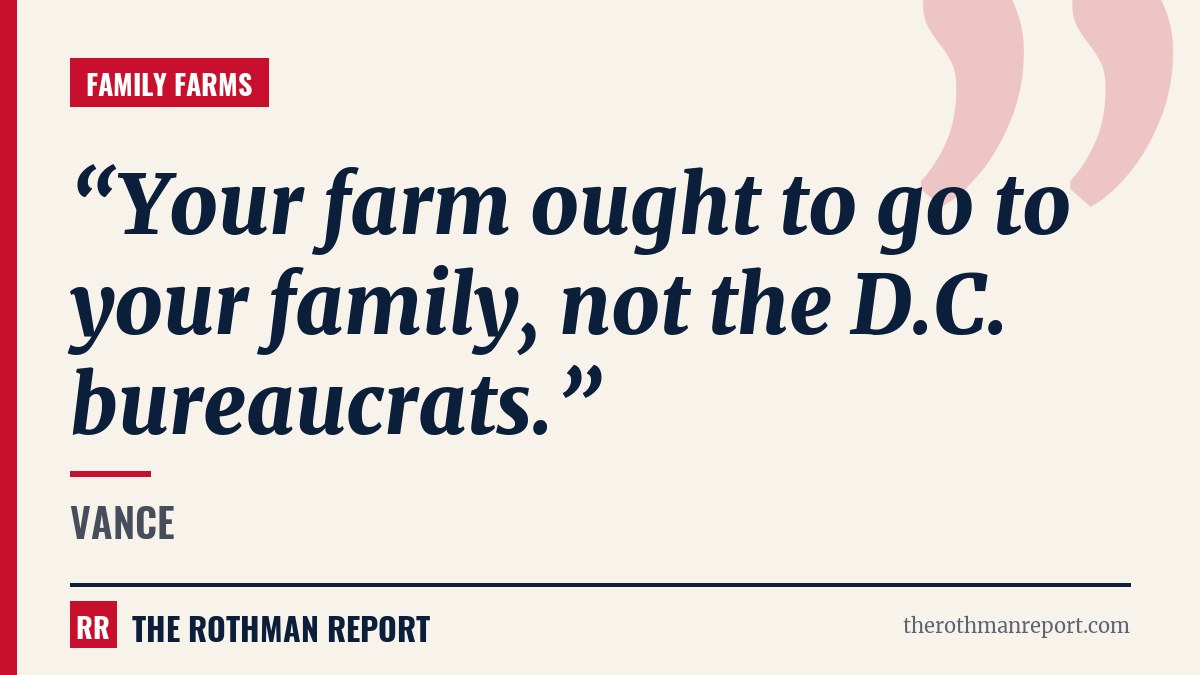
He closed the thought with the line that drew the crowd: “When you work that farm for 50, 60, 70 years, and you go and meet the Lord, your farm ought to go to your family, not the D.C. bureaucrats. And that’s how it is now.”
Local coverage of the rally reported that Vance praised the administration’s immigration, tax and trade policies and argued that the election will decide whether Washington stands with Iowa farmers. He appeared alongside Zach Lahn, the Republican nominee for governor, and Chris McGowan, the Republican candidate in Iowa’s 4th Congressional District.
What the law actually does
The estate tax, created in 1916, is levied at a top rate of 40 percent on the value of an estate above the exemption amount. According to the IRS, Public Law 119-21, signed July 4, 2025, amended Section 2010(c)(3) of the tax code to set the basic exclusion amount at $15,000,000 for calendar year 2026, up from $13.99 million in 2025. A married couple, using the portability rules that let a surviving spouse claim a deceased spouse’s unused exemption, can shelter roughly $30 million.
The word “permanent” matters here because of what the 2017 Tax Cuts and Jobs Act did. That law doubled the exemption but wrote in an automatic sunset. As the law firm Frost Brown Todd explained in its analysis of the 2025 bill, without new legislation the exemption would have dropped to about $7.2 million on January 1, 2026. The 2025 law not only prevented that cut, it rounded the figure up to $15 million and set future inflation adjustments from that new base.
The same analysis is careful about what “permanent” means in Washington: there is no expiration date, so the exemption will not fall unless a future Congress and president pass a new law to cut it. In other words, the default is now protection for family estates rather than an automatic tax hike. Anyone who wants to bring the old limit back has to vote for it in public.
What was at stake for farmers
The Agriculture Department’s own economists ran the numbers before the 2025 law passed. In a March 2024 analysis, the Economic Research Service estimated that letting the higher exemption expire would raise the share of farm operator estates owing federal estate tax from 0.3 percent to 1.0 percent. Of the roughly 40,883 farm estates expected to be created in 2026, the number owing tax would have jumped from 120 to 424. Total federal estate taxes paid by farm estates would have more than doubled, to $1.2 billion.
The hardest hit would have been larger family operations. ERS found that among farms with gross cash income between $1 million and $5 million, the share of estates owing tax would have climbed from 2.8 percent to 7.3 percent.
Critics of the higher exemption point out, accurately, that only a small fraction of estates owe the tax in any year. ERS estimated that just 89 farm estates likely owed it in 2023. But that statistic understates the problem. Farm wealth is tied up in land, buildings, equipment and livestock, not cash. A family that owes a 40 percent tax on the value of land it has no intention of selling has two choices: sell part of the operation or spend years and fortunes on estate planning to avoid doing so. The estate tax’s reach is measured not only in who pays it, but in what families do to avoid it.
The political point
Vance’s message in Council Bluffs was simple: the administration delivered something concrete for rural families, and the November election will decide whether it stays that way. The law’s cost, which the Joint Committee on Taxation and the Congressional Budget Office put at $212 billion over 10 years according to Frost Brown Todd, will be a talking point for Democrats who want it rolled back.
Iowa farmers can weigh that against the alternative they were facing on January 1, 2026: an exemption cut roughly in half, more than three times as many farm estates owing tax, and federal estate taxes on farm estates more than doubled.
A family that spends 70 years building a farm should hand it to its children, not to the IRS, and this administration wrote that into law without an expiration date.
Editor’s note: This article covers the estate tax provisions of the tax law signed in July 2025, which drew renewed attention in September 2026 after Vice President Vance’s remarks in Iowa.
Sources
- IRS: What's new — Estate and gift tax
- RNC Research on X: Video of JD Vance in Council Bluffs, Iowa (Sept. 18, 2026)
- KGAN via NewsChannel 9: Vance rallies Iowa Republicans in Council Bluffs ahead of midterms (Sept. 18, 2026)
- USDA Economic Research Service: Expiring estate tax provisions would increase the share of farm estates that owe taxes
- USDA Economic Research Service: Forecast estimates 2 in 1,000 farm estates created in 2023 likely owed Federal estate tax
- Frost Brown Todd: One Big Beautiful Bill Act enacts a permanent increase in the estate and gift tax lifetime exclusion amount (July 2025)
More from The Rothman Report
 Lifelong Democrat Sheriff Quits the Party After Locals Told Him to Leave for Backing Rogers and James
 Taco Bell Coworker’s Tip Stopped a Self-Described Neo-Nazi’s Alleged Plot Against an Aurora Hindu Temple
 Paralympian Veteran Waited 5 Years for a Wheelchair Lift. She Says Canada Offered Her Assisted Death.