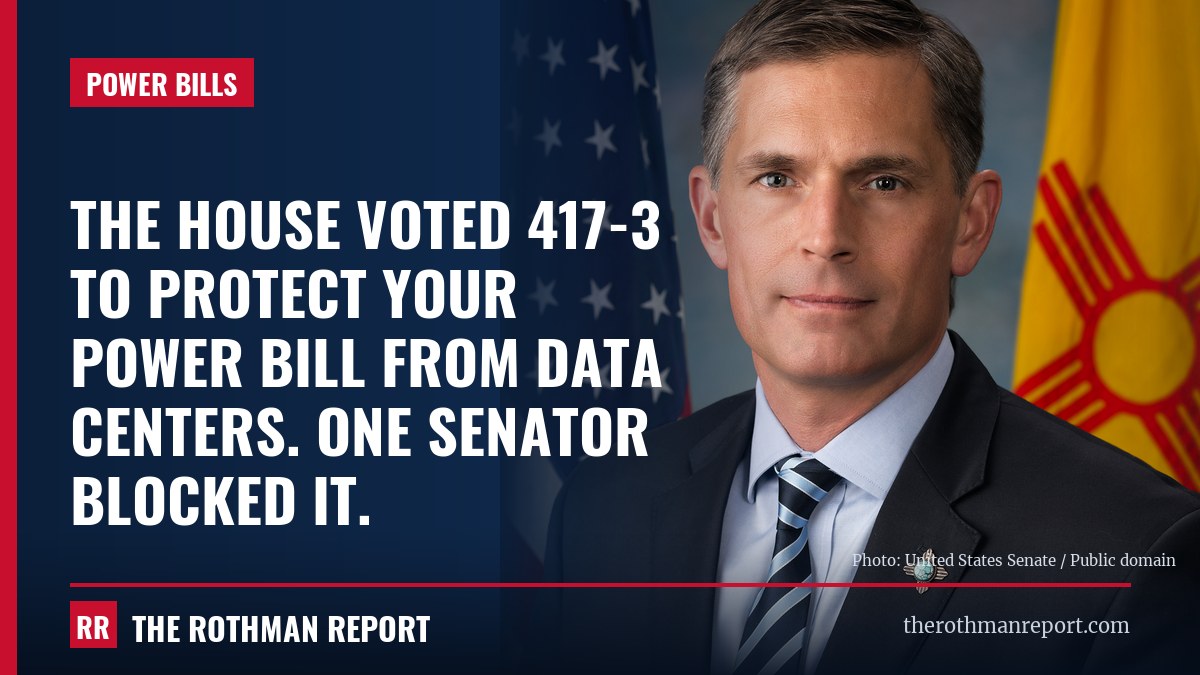

A bill to keep families from paying for Big Tech’s power grid passed the House 417 to 3 on Wednesday, September 16. One day later, a single Democratic senator stopped it cold. On Thursday, Sen. Martin Heinrich of New Mexico objected when Sen. Jon Husted of Ohio asked the Senate to pass the Ratepayer Protection Act by unanimous consent, a move that would have sent it to President Trump’s desk.
It is hard to find anything 417 members of the House agree on. Heinrich found a way to make it irrelevant.
What the bill does
The Ratepayer Protection Act, H.R. 9340, is aimed at a problem anyone with an electric bill has started to notice. Data centers, many of them built to run artificial intelligence, are driving a surge in electricity demand, and the cost of new generation, transmission and distribution upgrades needed to serve them can end up spread across ordinary customers.
The House bill was led by Rep. Gabe Evans, a Colorado Republican, with Rep. Kathy Castor, a Florida Democrat, as its main co-sponsor. Husted carries the Senate companion. According to Colorado Politics and Newsweek, the bill:
- Targets data centers with peak demand of 100 megawatts or more at a single site or campus.
- Creates a federal standard under which those facilities cover the full incremental cost of the grid upgrades built to serve them, rather than passing it to households.
- Requires financial assurances before utilities start upgrades, so a data center remains on the hook even if its project is canceled or moved.
- Amends the Public Utility Regulatory Policies Act so that state regulators must begin considering the standard within one year and decide whether to adopt it within two years.
“Hardworking families should not have to subsidize the energy demands of data centers,” Evans said in a statement after the House vote. Castor, from the other side of the aisle, made the same case: Big Tech, not families, farms or small businesses, should pay for the power its data centers need.
The bill had cleared a House committee the previous month on a rare unanimous vote. The only three no votes came from Democrats on the left, among them Rep. Rashida Tlaib of Michigan, who said it didn’t do enough to “meaningfully protect our communities” and called for a national moratorium on data centers.
One objection
On the Senate floor on September 17, Husted made his pitch. “Mr. President, America is expected to build the equivalent of 1,000 major data centers during the next five years,” he said. “And we need to protect American ratepayers from footing the bill.” He called the House measure “the most meaningful, bipartisan step Congress could take to protect the American people from higher prices for electricity.”
Under Senate rules, a unanimous consent request dies if a single senator objects. Heinrich, the top Democrat on the Senate Energy and Natural Resources Committee, objected. He argued the bill “falls short of what we need to do to respond” and said, “I don’t think it’s enough to just take their word for it,” referring to the tech companies. Congress, he said, “needs to pass real legislation with real teeth.”
He then asked for unanimous consent on his own measure, the GRID Savings Act, which he said would “require large load customers like data centers to pay for the facilities needed to connect them to the grid.” Ohio Republican Sen. Bernie Moreno objected to that. Moreno’s verdict on the afternoon: “The term do-nothing Congress exists for a reason. We absolutely accomplished that right now.”
Husted, for his part, promised to keep going. “It is a shame that this opportunity has been missed today, but I will be back to push this issue forward.”
The other side
Heinrich’s criticism is not nothing. The bill does not force any state to adopt the standard; it requires states to consider it and decide. It sets no national rate and does not promise a specific savings figure. According to the American Public Power Association, Democrats describe it as a voluntary standard and only a starting point. Heinrich also argued that data centers should do more to engage communities and conserve water.
But that is an argument for amending a bill later, not for killing relief that 417 House members, Republicans and Democrats alike, were ready to send now. The House did not pass this by accident. It passed it because voters are already angry. An Economist/YouGov poll taken August 28-31 found 60% of respondents believed a new local data center would raise their electricity bill.
There is also a political subtext. Husted faces Democrat Sherrod Brown in Ohio’s Senate race this fall, and Brown has attacked Husted’s record on data-center development. A Husted win on ratepayer protection, signed into law weeks before the midterms, is not something Senate Democrats had any reason to hand him.
Why it matters
The pattern is familiar. A popular, bipartisan, narrowly drawn bill clears one chamber by a historic margin. Then a senator who prefers his own version uses procedure to stop it, and the public gets nothing while both sides blame each other. The difference here is the scoreboard: 417 to 3 in the House, and one objection in the Senate.
Families paying higher power bills this winter will not care whose name was on the bill. They will care that the Senate had a chance to act and didn’t.
Four hundred seventeen House members voted to protect your electric bill, and one Democrat senator decided his own bill mattered more.
Sources
- Colorado Politics: House passes Gabe Evans' bill aiming to prevent data centers from driving up electricity costs (Sept. 16, 2026)
- Newsweek: Data center bill hits roadblock in Senate: what happens next (Sept. 18, 2026)
- FOX 2 KTVU: Senate Democrat blocks data center electricity costs bill (Sept. 18, 2026)
- American Public Power Association: Ratepayer Protection Act is Blocked in Senate (Sept. 18, 2026)
- Capital and Compute: Senate Blocks Data Center Bill (Sept. 17, 2026)
More from The Rothman Report
 Netanyahu Answers Obama’s Belfast Attack: ‘We’re Not the Belgians in the Congo, We’re Jews in Judea’
 Lifelong Democrat Sheriff Quits the Party After Locals Told Him to Leave for Backing Rogers and James
 Taco Bell Coworker’s Tip Stopped a Self-Described Neo-Nazi’s Alleged Plot Against an Aurora Hindu Temple