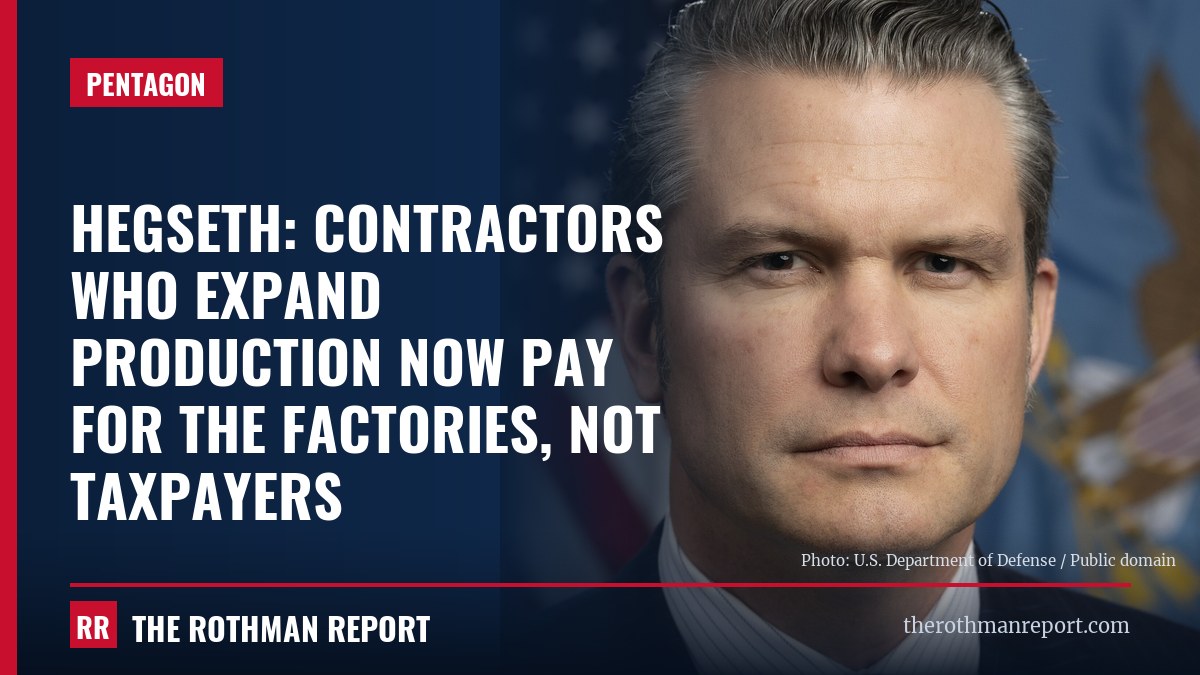

Secretary of War Pete Hegseth says the Pentagon is done paying defense contractors twice. Under a new negotiating approach run by a group of private-sector dealmakers he calls “Deal Team Six,” companies that want to expand production to sell more to the military are now expected to pay for their own factories, in exchange for steady, long-term orders.
Hegseth laid out the policy in a video first released on May 7, 2026. The clip drew a fresh wave of attention in mid-September as it circulated again on social media, and the argument in it is worth revisiting, because it goes to the heart of how Washington buys weapons.
“Double dip at your expense”
In the video, Hegseth describes a system in which the taxpayer financed the same capability twice. “When our warfighters needed more weapons, aircraft, and ships, the Department of Defense allowed contractors to double dip at your expense,” he says. “They charge you, the taxpayer, to build their factories and then charge you again for the final product.”
He went on: “And despite paying companies to make weapons faster, schedule delays were constant and cost overruns were the norm, all while their CEOs got rich.”
His answer is a personnel change as much as a policy change. “We’re not tolerating delays in production or cost overruns anymore,” Hegseth says. “We’ve pushed out the bureaucrats who’ve made these deals in the past and replaced them with the most talented negotiators in the private sector.” And then the line that sums up the pitch: “We now move at the speed of business, not bureaucracy.”
How the new deal works
The core change is who carries the capital cost of expansion. “Now when a defense company expands its production to sell more equipment to the U.S. military, they pay the bill,” Hegseth says. “They pay for new factories, assembly lines, manufacturing plants, not the taxpayer.”
In return, according to Military Times, the department offers steady, long-term orders for what service members need, with the goal of higher production volumes, faster delivery and flat pricing. Hegseth claims that is already happening: “defense companies are making things in higher volumes, much more quickly while keeping their prices flat.” He did not cite specific contracts or figures in the video.
There is also a stick. “Should these companies fail to deliver, we will hold them accountable and bring in new companies who will,” he says. “Speed, volume, and fiscal responsibility. It’s common sense, and it’s what the American taxpayer demands.”
Who is Deal Team Six?
According to Military Times, Deal Team Six is housed within the Pentagon’s Economic Defense Unit, which stood up in early April 2026 following a Hegseth memo from November 2025. The unit is directed by George Kollitides, the former head of defense at Cerberus Capital Management, as first reported by the Wall Street Journal. Military Times reported that the team’s full roster had not been made public.
Bloomberg Government reported that Kollitides was named the unit’s inaugural director on February 4, 2026, and that the unit’s broader job is to identify strategic investments and draw public and private capital toward technologies such as rare earth minerals, artificial intelligence and quantum computing. The same report noted that six days after his appointment, Kollitides joined the board of a blank-check company, an arrangement a Campaign Legal Center attorney said “seems to be” a conflict of interest. That is a fair question, and one the department should answer in public as the unit’s power over contracts grows.
Congress has funded the effort. Per Military Times, the unit received more than $266 million in research, development, test and evaluation money in the fiscal 2026 National Defense Authorization Act, and the fiscal 2027 request allots it more than $593 million.
The $1.5 trillion context
Hegseth framed the reform as part of President Trump’s fiscal 2027 defense request, which Breaking Defense reported in April at $1.5 trillion: $1.15 trillion in the base budget, the first time base defense spending has topped $1 trillion, plus $350 billion from a planned reconciliation bill. The request includes $65.8 billion for Navy shipbuilding, up from $27.2 billion enacted for fiscal 2026, and a large increase in missile procurement. As with any budget request, Congress decides how much of it becomes law.
In the video, Hegseth promised, “We’re going to spend every dollar of that money responsibly because that’s what you deserve.”
Critics were unimpressed. As reported by Common Dreams, former Rep. Justin Amash said the budget means “hundreds of billions more in waste and fraud,” and a Quincy Institute analyst wrote that the increase “seems to be” unhinged “from reality and sober policymaking.” Their argument is that a budget this size makes any claim of thrift hard to take at face value.
Why it matters
The critics have a point about scale, and that is exactly why the contracting reform matters. The bigger the budget, the more it costs taxpayers when the Pentagon pays for the plant, pays for the product and then pays again for the delays. If Deal Team Six actually shifts the cost of expansion onto the companies that profit from it, and actually replaces suppliers who miss deadlines, it could save taxpayers real money on every program that needs a bigger production line.
The test is results. Hegseth has made a specific, checkable promise: higher volume, faster delivery, flat prices, and new suppliers for anyone who fails. Americans should hold him to it, and they should demand to see the contracts that prove it.
For decades the taxpayer bought the factory and the weapon too, and the least a $1.5 trillion budget owes us is paying for each only once.
Editor’s note: This article covers a May 2026 video by Secretary of War Pete Hegseth announcing the Deal Team Six contracting approach, which drew renewed attention in September 2026.
Sources
- Military Times: Hegseth aims to cut through the bureaucracy with 'Deal Team Six' (May 8, 2026)
- Breaking Defense: Golden Dome, out years and lots of missiles: Details of Trump's $1.5T defense budget request (Apr. 3, 2026)
- Bloomberg Government: Pentagon Investment Arm Director Joined Firm With Defense Ties (July 29, 2026)
- Common Defense: Hegseth Targets Pentagon Deadweight with 'Deal Team Six' (May 2026)
- Common Dreams: Hegseth Lampooned for Video Claiming $1.5 Trillion Pentagon Budget Puts 'American Taxpayer First' (May 7, 2026)
More from The Rothman Report
 Lifelong Democrat Sheriff Quits the Party After Locals Told Him to Leave for Backing Rogers and James
 Taco Bell Coworker’s Tip Stopped a Self-Described Neo-Nazi’s Alleged Plot Against an Aurora Hindu Temple
 Paralympian Veteran Waited 5 Years for a Wheelchair Lift. She Says Canada Offered Her Assisted Death.