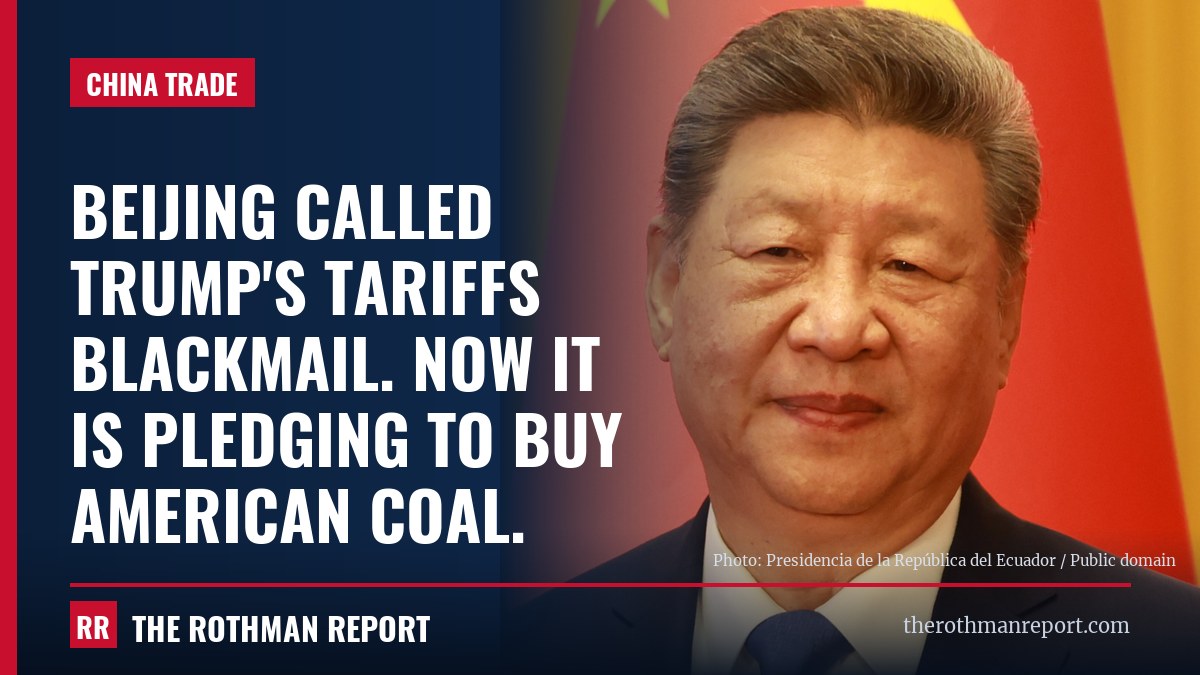

China has agreed to buy at least 10 million metric tons of American coal in 2027 and again in 2028, and the two countries have agreed to pursue lower tariffs on $30 billion of goods in each direction, the White House announced after Chinese President Xi Jinping’s state visit to Washington this week. It is a modest package, not a grand bargain, but it runs in one direction: Beijing coming back to the table and buying American after a year of trade war it did not win.
Xi’s three-day visit, hosted by President Trump and first lady Melania Trump, was the first state visit by a Chinese leader to the United States in more than a decade, according to Politico. It came after Trump’s own summit in Beijing in May 2026, where the two sides chartered the trade mechanisms that were switched on this week.
What the deal actually says
According to the White House fact sheet released September 25, the two leaders put into operation a new Board of Trade and Board of Investment. Under the Board of Trade, the two countries reached consensus on recommendations for “more favorable tariff treatment” for $30 billion of non-sensitive goods in each direction.
On the American export side, the list covers agricultural products, seafood, wood and log products, cosmetics and medical devices. On the import side, the U.S. would consider better treatment for Chinese consumer goods such as small appliances, toys, holiday decorations and children’s car seats. A new working group will focus on market access barriers in the agricultural sector, which Politico described as trade barriers to U.S. farm products.
It is worth being precise here: no tariff cuts were implemented on the spot. Politico reported that the Board of Trade lays the groundwork for those carve-outs, and the Associated Press described the two sides as continuing to work toward the reductions. The lists are set. The rates and timing are still to come.
The coal commitment
The firmest number in the package is coal. The fact sheet states that China will import “at least 10 million metric tons of coal from the United States in 2027 and again 2028.”
That matters because of what came before it. As Breitbart News noted in its report on the deal, China had been among the five largest buyers of U.S. coal before it sharply cut those purchases in 2025, at the height of the tariff fight. Pulling back on American coal was part of how Beijing fought the trade war. Now it is committing, on paper, to buy again.
There is a caveat, and it is an important one. Politico reported that China’s own readout of the summit does not mention the coal pledge at all. Beijing has a long history of trumpeting purchase commitments abroad and going quiet about them at home. The proof will be in the shipping manifests in 2027, not in the fact sheet.
From “blackmail” to the Board of Trade
Eighteen months ago, the tone out of Beijing was very different. In April 2025, after Trump threatened an additional 50 percent tariff on Chinese goods, China’s government said it would never accept what it called the “blackmail tactics” of the United States and vowed to fight to the end.
The fight did not go the way Beijing promised. The two sides hammered out a trade truce in South Korea in 2025. This week, Treasury Secretary Scott Bessent announced that truce has been extended, pushing back the possible return of triple-digit tariffs and Chinese export controls on critical minerals until early 2027, according to Politico. Meanwhile, the summit produced American wins on fentanyl: the White House says China imposed new export controls on two fentanyl precursor chemicals and, in August, acting on information from U.S. law enforcement, arrested 21 Chinese citizens for making and distributing precursor chemicals to illicit drug producers in North America.
The fact sheet also records China signing on to two lines Washington cares about in the Middle East: that “Iran can never have a nuclear weapon” and that “no country or institution can be allowed to impose tolls on international waterways.”
What is still unresolved
None of this makes the Chinese Communist Party a trustworthy partner. The White House fact sheet says only that the two countries “continue to work on U.S. concerns” about rare earth and critical mineral shortages, with the goal of restoring shipments to appropriate levels. That is diplomatic language for “China is still holding back.” Politico reported that rare earth export restrictions are not addressed in the Chinese readout at all.
Critics also noted what is not in the package. Former national security official Craig Singleton told Politico “The omissions are revealing,” pointing out that chips, semiconductor equipment and export controls are absent because those issues increasingly sit inside the national security competition rather than ordinary commercial bargaining. Trump, for his part, made clear he has no intention of sharing America’s lead in advanced computing. China wants to stop American progress, he told reporters, “because we’re leading China by a lot and we’re going to keep it that way,” according to the AP.
The leaders plan to meet again at the APEC summit in Shenzhen in November and at the G20 at Trump National Doral Miami in December.
The honest scorecard is this: a coal commitment that Beijing will not even admit to at home, a list of tariff relief that still needs rates and dates, and a truce that keeps America’s leverage in reserve. That is not capitulation by Xi. But it is a regime that once called American tariffs blackmail now negotiating inside a framework Washington set, and agreeing to buy American energy it had cut off.
Beijing called American tariffs blackmail, and now it is signing up to buy American coal, so the leverage clearly worked; the job now is making China actually deliver.
Sources
- The White House: Fact Sheet: President Donald J. Trump Advances a Fair and Reciprocal Relationship with China While Hosting Historic State Visit (Sept. 25, 2026)
- Associated Press via PBS NewsHour: China and U.S. agree to establish AI safety channel and continue trade and military talks (Sept. 26, 2026)
- Politico via Yahoo News: Xi visit delivers coal deal, tariff talks, and plenty of unresolved issues (Sept. 26, 2026)
- Breitbart News: Trump-Xi Summit: U.S., China Agree to $30 Billion Tariff Deal, Coal Purchases (Sept. 26, 2026)
- All India Radio (Akashvani) News: China slams U.S. blackmail tactics after Trump threatens 50% tariff hike (Apr. 8, 2025)
More from The Rothman Report
 Lifelong Democrat Sheriff Quits the Party After Locals Told Him to Leave for Backing Rogers and James
 Taco Bell Coworker’s Tip Stopped a Self-Described Neo-Nazi’s Alleged Plot Against an Aurora Hindu Temple
 Paralympian Veteran Waited 5 Years for a Wheelchair Lift. She Says Canada Offered Her Assisted Death.