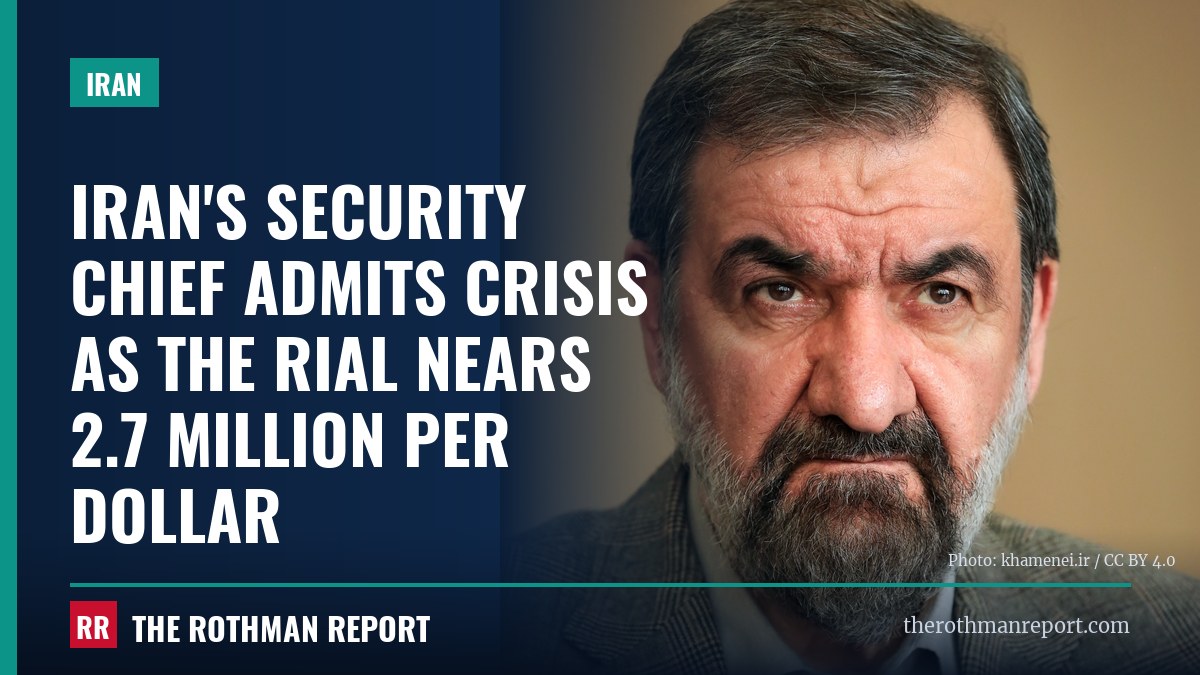

One of the most hardline figures in Iran’s ruling establishment has admitted what ordinary Iranians already know: the regime’s economy is in free fall. Mohsen Rezaei, secretary of Iran’s Supreme National Security Council and a former commander in chief of the Islamic Revolutionary Guard Corps, told a high-level government meeting on Saturday, October 3, 2026, that the country is in one of the most difficult periods it has ever faced.
Iran’s state news agency IRNA paraphrased Rezaei as having “described the circumstances as among the most difficult periods the country has faced,” according to Colorado Politics. The New York Times, which described Rezaei as Iran’s top security official, reported that the meeting was focused on stabilizing an economy battered by more than seven months of war.
The rial keeps breaking records
The numbers explain the candor. Reuters reported that the Iranian rial hit a new record low on October 3 of about 2.688 million rials to the U.S. dollar, according to Oilprice.com and Legal Insurrection, which cited the Reuters report. As recently as early September, Euronews reported that the dollar had broken 2.1 million rials for the first time, up from about 1.35 million in March.
Put another way: in roughly seven months, the rial has lost about half of its value, and Iranians holding savings in their own currency have watched their purchasing power collapse. Colorado Politics, citing the currency tracker Alanchand, reported the rial was at about 1.111 million to the dollar a year earlier.
Iran’s central bank has tried to stem the slide. Governor Abdolnaser Hemmati said in September that the bank was ready to inject $2 billion into the foreign exchange market, blaming the collapse largely on what he called “psychological factors.” The rial kept falling anyway. Hemmati put September inflation at 83.8 percent, barely below August’s 84.4 percent, according to Colorado Politics.
Official Iranian figures show the economy shrank 10.1 percent year over year in the first quarter of the Persian calendar year, from March 21 to June 20, with oil and gas output down 26.4 percent.
The oil minister walks out
Then, on Sunday, October 4, Oil Minister Mohsen Paknejad resigned. State media initially gave no reason. Oilprice.com reported that President Masoud Pezeshkian’s office later said Paknejad had asked to leave for “personal reasons” and had made the request “a long time ago,” and that Pezeshkian had previously rejected it. Hamid Bovard, head of the National Iranian Oil Company, was named acting minister. Bovard has been under U.S. Treasury sanctions since February 2025.
The timing is hard to ignore. Paknejad had said in July that Iran would continue exporting oil despite U.S. sanctions, according to the New York Times. According to Oilprice.com, Treasury Secretary Scott Bessent said on October 3 that Iran had no oil shipments left at sea and would earn zero oil revenue that week. Colorado Politics reported that Bessent said Iran loaded zero crude onto tankers in September, and that Iran has gone nearly three months without a new oil tanker reaching China, its last major customer.
The blockade is working
The main reason is the U.S. naval blockade of Iranian ports, reimposed on July 14. On October 6, the Kuwait News Agency reported that U.S. Central Command said American forces had redirected 130 commercial vessels while enforcing it, disabled three ships that refused to comply, and over the past 12 weeks destroyed 13 commercial vessels that were either breaking the blockade or part of what CENTCOM called the IRGC’s “multibillion-dollar shadow network.”
CENTCOM commander Adm. Brad Cooper left no doubt about what comes next: “The U.S. military remains intensely focused on this mission. We will swiftly act against any vessels trying to run the blockade. Our forces are highly trained, professional, and lethal.”
The blockade works alongside the Treasury Department’s sanctions campaign, which Colorado Politics described as adding secondary sanctions and a crackdown on the regime’s financial and smuggling networks beginning in mid-August.
Who pays the price
Inside Iran, the pain is falling on the people the regime claims to represent. The New York Times reported that government and private-sector workers, including nurses and teachers, have posted on social media that they are quitting because their salaries can no longer cover the cost of living, and that retired government employees have protested in recent weeks after not receiving their full pensions.
That is the regime’s choice. For decades, Tehran’s rulers have poured national wealth into the Revolutionary Guards, missile programs and terrorist proxies across the region, from Hezbollah to Hamas to the Houthis, while the Iranian people’s standard of living has eroded. Now that the money is running out, the cost of those priorities can no longer be hidden.
Rezaei’s admission matters precisely because of who he is. He is not a reformer looking to score points against hardliners. He is a former IRGC commander, among the regime’s most uncompromising figures. When a man like that tells a room of officials that the country is in one of its darkest periods, he is not exaggerating for effect.
When the regime’s own security chief admits the economy is collapsing, it is not American propaganda; it is maximum pressure doing exactly what it was designed to do.
Sources
- Colorado Politics: Top Iranian official admits dire state of the economy: Report (Oct. 6, 2026)
- Kuwait Times (KUNA): US forces redirect 130 vessels under Iran blockade (Oct. 6, 2026)
- Oilprice.com: Iran's Oil Minister Resigns as US Blockade Chokes Crude Exports (Oct. 5, 2026)
- The Star (Reuters): Iran's oil minister resigns, state media says (Oct. 5, 2026)
- Euronews: Iranian rial hits record low against the US dollar (Sept. 2, 2026)
- Legal Insurrection: Iran's economy 'deteriorating rapidly,' regime's national security chief Rezaei admits (Oct. 6, 2026)
More from The Rothman Report
 Lifelong Democrat Sheriff Quits the Party After Locals Told Him to Leave for Backing Rogers and James
 Taco Bell Coworker’s Tip Stopped a Self-Described Neo-Nazi’s Alleged Plot Against an Aurora Hindu Temple
 Paralympian Veteran Waited 5 Years for a Wheelchair Lift. She Says Canada Offered Her Assisted Death.