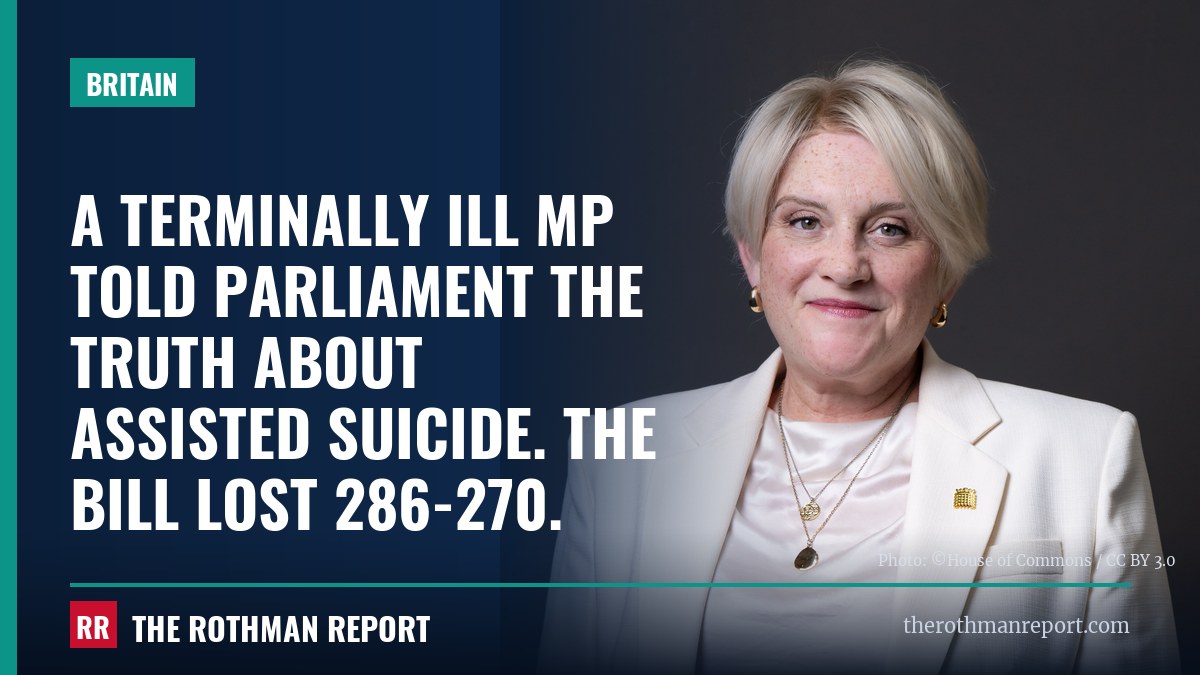

Britain’s House of Commons voted down a bill to legalize assisted suicide in England and Wales on Friday, September 11, 2026, by 286 votes to 270. One of the most powerful speeches against it came from a Labour MP who is herself terminally ill: Ashley Dalton, who is living with stage 4 incurable metastatic breast cancer.
Dalton, the member for West Lancashire, told her colleagues that the last time they debated the bill she had been hiding her diagnosis from them. Then she explained, from the inside, exactly why a law sold as compassion for people like her would put people like her in danger.
“I was keeping a secret”
The bill, the Terminally Ill Adults (End of Life) Bill, would have allowed adults in England and Wales with fewer than six months to live to apply for an assisted death, subject to approval by two doctors and an expert panel, according to the Press Association. It was reintroduced this session by Labour MP Lauren Edwards after a near-identical version, brought by Labour MP Kim Leadbeater, passed the Commons and then ran out of time in the House of Lords.
Dalton opened with a confession. According to a transcript of the speech published by the Euthanasia Prevention Coalition, she said: “The last time this House considered this bill at Second Reading I was keeping a secret.” She went on: “I was told I have stage 4 incurable metastatic breast cancer.”
What followed was not a philosophical argument. It was testimony. “I was overwhelmed with grief fear and anxiety,” she said. And then the admission no supporter of the bill could easily answer: “I would be lying if I said that when thinking about all that was to come I didn’t consider that it might just be fairer and easier on everyone if I just got the dying done as soon as possible.”
Her point was clinical, not sentimental. “Suicide risk is highest immediately after diagnosis and it usually falls quickly within three to six months,” she said. “Having treatable depression however will not exclude anyone from an assisted death in this bill and depression is common among people with terminal illness but it is often treatable.” A solicitor watching from the public gallery, writing in the Law Society Gazette, noted that Dalton spoke openly about having been at risk of suicide, and that she was treated for depression along the way.
The doctors said no
Dalton made clear she was not speaking for herself alone. “The Royal College of Psychiatrists, the Association of Palliative Medicine, the Royal College of Physicians all say the bill is seriously inadequate,” she said. “They aren’t opposed to assisted dying in principle, but they cannot support this bill.”
She drew a sharp line between mental capacity, which the bill tested, and mental health, which it did not. “The three person panel at the end of the assessment process in this bill is not what most NHS clinicians recognize as a multi-disciplinary team,” she said, arguing that the assessment needed to happen at the start of the process, with each professional independently assessing the patient in person. The Press Association reported that the Royal College of Psychiatrists had warned there were “too many unanswered questions about the safeguarding of people with mental illness.”
She also took on the strategy behind the bill. Supporters reintroduced it in nearly identical form so the rarely used Parliament Acts could force it past the Lords without amendment. Dalton asked why its backers had not spent the summer working with the medical colleges instead. “This is not about sides, this House is not a debating society, it is about making the law,” she said.
“It’s a threat”
Then Dalton turned on the scare campaign that had been aimed at patients like her. “People, I, have been terrorized with tales of people vomiting up their own feces as though this is common place during death. It is vanishingly rare,” she said. Bowel obstructions are more common, she added, but treatable: “I know, I have had one.”
She called that messaging “nothing short of irresponsible” and said “Palliative care in the UK is excellent,” while conceding that far too many people cannot get it. Her conclusion was blunt: “A terrible death or an assisted death is not a choice it’s a threat.”
And she named who would pay the price: “This bill does not protect the most vulnerable, it does not protect the poor, the old, people with disabilities” or ethnic minorities, she said, nor people who are mentally ill. She urged her colleagues to vote no or abstain.
A 16-vote defeat
They listened. The bill fell by a majority of 16. The government was officially neutral and MPs voted their consciences; Prime Minister Andy Burnham abstained, the Press Association reported. Columnist Madeline Grant, writing in The Spectator, called Dalton one of the most affecting speakers of the day and reported that the swing was driven largely by previous supporters abstaining and previous abstainers voting no.
Supporters were bitter. Edwards called the result “hugely disappointing” and said: “Parliament has dropped the ball today.” Dalton, for her part, said the outcome was “not a moment for celebration” and called on the government to “sort out social and palliative care.”
The stakes were not abstract. Writing in UnHerd, Yuan Yi Zhu reported that a government impact assessment released about a week before the vote raised its estimate of assisted deaths in the first decade from 13,500 to more than 25,000. Projections that nearly double before a law even passes are not a reassuring sign of where the guardrails would end up.
Dalton, who says she lives between scans in nine-to-12-week blocks, put it simply: “My days could be numbered but that doesn’t mean that I want this Chamber to rush through bad law just so I might have a chance to see it or use it.”
The people most trusted to speak for the dying were dying themselves, and when one of them stood up and said this bill would hurt people like her, Parliament finally had the decency to listen.
Sources
- Euthanasia Prevention Coalition: Ashley Dalton (Labour MP) speaks out against UK assisted suicide bill (Sept. 14, 2026)
- Press Association via The Irish News: MPs reject attempt to legalise assisted dying in England and Wales (Sept. 11, 2026)
- The Spectator: On assisted dying, sense prevailed (Madeline Grant, Sept. 2026)
- Law Society Gazette: Witnessing the assisted dying debate in the Commons (Sept. 2026)
- UnHerd: Assisted dying bill's defeat is a victory for human dignity (Sept. 11, 2026)
More from The Rothman Report
 Lifelong Democrat Sheriff Quits the Party After Locals Told Him to Leave for Backing Rogers and James
 Taco Bell Coworker’s Tip Stopped a Self-Described Neo-Nazi’s Alleged Plot Against an Aurora Hindu Temple
 Paralympian Veteran Waited 5 Years for a Wheelchair Lift. She Says Canada Offered Her Assisted Death.