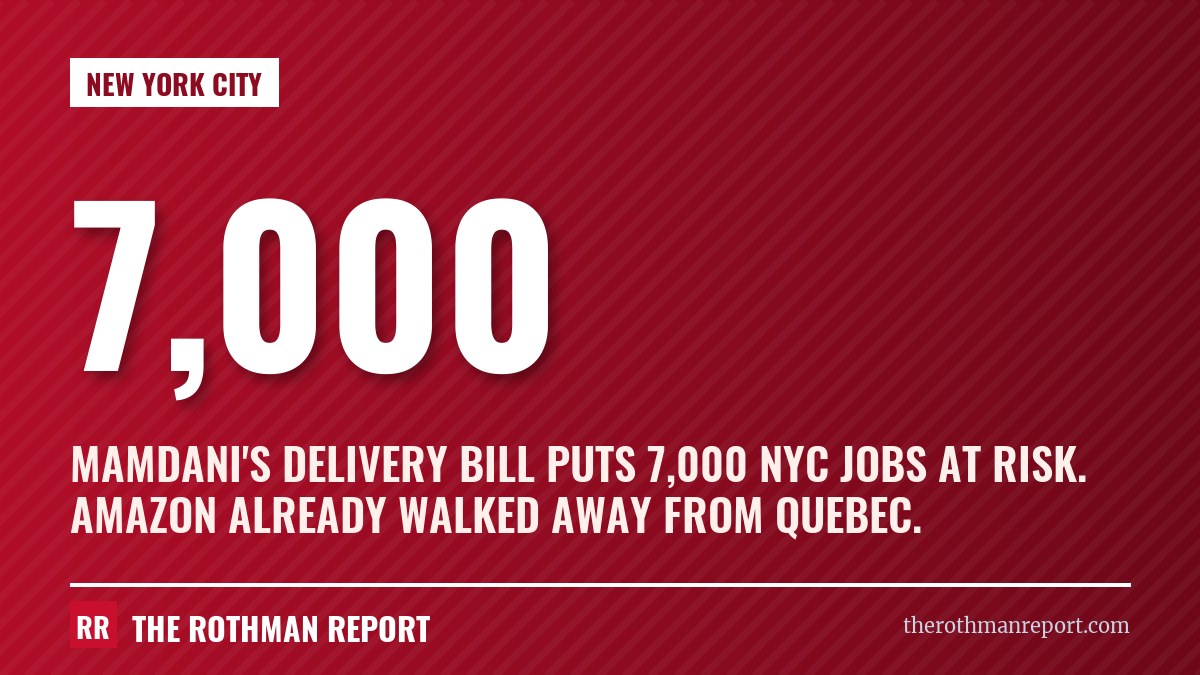

Amazon has said it may close more than a dozen New York City warehouses and move thousands of workers out of the five boroughs if the City Council passes the Delivery Protection Act, a labor bill backed by Mayor Zohran Mamdani. Industry experts told the New York Post on October 16, 2026, that the company is likely to follow through. In the worst case, about 5,000 delivery jobs leave the city, Amazon shuts its 15 last-mile warehouses, and the roughly 2,000 people who staff them lose their jobs too.
That adds up to about 7,000 jobs. These are not white-collar headquarters jobs. They are drivers, sorters and the small local companies that employ them.
What the bill actually does
The legislation is Introduction 518, sponsored by Queens Council Member Tiffany Cabán and introduced on February 12, 2026. According to the Council’s own record, it would require operators of last-mile warehouses, the facilities that send packages out for final delivery, to get a business license from the city’s Department of Consumer and Worker Protection, with safety, training and employment conditions attached. The Council’s record lists more than 30 sponsors. The bill has been laid over in the Committee on Consumer and Worker Protection since a hearing on April 9.
The key provision is the employment rule. As amNY reported, the bill would require workers who perform core warehouse and delivery work to be employed directly by the facility operator. That would generally ban third-party contracting for those jobs starting in the 12th month after enactment. Today Amazon’s New York deliveries are handled by about 40 independent Delivery Service Partners, which employ roughly 5,000 drivers. Under the bill, Amazon would have to hire those drivers itself. The Post notes that Amazon does not directly employ delivery workers anywhere else in the country.
Mamdani endorsed the bill on August 10. “Corporations like Amazon build billion-dollar business models by insulating themselves from accountability through a system of exploitative subcontracting,” he said in a statement. Cabán went further: “For too long, companies like Amazon have operated in our city like it’s the Wild West, ignoring workers’ rights, putting our communities in danger, and acting with impunity.”
Quebec already showed how this ends
There is a recent precedent for what Amazon does when a government or union goes after its delivery model. In January 2025, after the Confédération des syndicats nationaux (CSN) union organized a last-mile warehouse in Laval, near Montreal, Amazon announced it would close all seven of its Quebec warehouses. Amazon denied that the closures had anything to do with the union. It told Radio-Canada it was returning to “a third-party delivery model, supported by small local businesses, similar to the one we had until 2020.”
The damage was not limited to Amazon’s own payroll. CBC News reported at the time that the closures had led to more than 4,500 layoffs, including more than 2,500 people who worked for subcontracted delivery companies. The Post puts the tally by March 2025 at some 1,900 Canadian warehouse workers and 2,800 delivery contractors. According to logistics consultant Marc Wulfraat, the Montreal-area buildings are now vacant, and Amazon is still paying rent on more than 1.6 million square feet of space.
“Amazon will retaliate, because it has to send a firm message to the rest of the country that ‘If you mess with us, this is what will happen,'” said Wulfraat, founder of the Montreal-based consulting firm MWPVL International.
Brittain Ladd, a logistics consultant and former Amazon executive, was just as blunt: “Amazon wouldn’t blink about shutting down the 15 facilities in New York City if it felt that the legislation was a threat to its business model. This is about a model that could be copied in other cities.”
Amazon says New York is “fundamentally different” from Quebec, where it operated “far fewer sites,” according to spokesperson Steve Kelly. The company employs, directly or indirectly, more than 12,000 hourly workers in New York, more than twice its Quebec headcount. But New Jersey is right across the river. Kris Basmagy, owner of DashWave Delivery, which runs Amazon deliveries on the Upper East Side, told the Post that nothing stops Amazon from serving the city out of “warehouses being built along the New Jersey Turnpike.”
The small businesses caught in the middle
The people with the most to lose are the ones the bill says it wants to protect. “Look at what happened in Quebec,” Basmagy said. “There was pressure on Amazon’s model, and it pulled out.” He employs 150 delivery workers. “There is a laser focus on punishing Amazon no matter what the repercussions might be, what it does to us as business owners, fathers and husbands. It’s as if we no longer exist.”
Joe Artus owns WGA Transit, which has actively recruited formerly incarcerated and homeless workers to deliver Amazon packages in Harlem. He told the Post the bill in its current form would put him out of business: “I have a 21-month-old daughter. If this thing passes, there is no way for my company to exist or to keep my 189 employees.”
At an August press conference in Harlem, Rudy Cazares of Cazar Logistics put it more simply: “Amazon is going to be fine. People like us are the ones who are going to pay the price.”
The other side, and where it stands
Supporters say the bill is about safety. As amNY reported, a 2025 city comptroller’s report found that injury-causing crashes rose in 78% of the areas around last-mile facilities after they opened, and more than 2,000 workplace injuries were reported to OSHA at those facilities from 2022 to 2024. Amazon disputed that report, saying it relied on incomplete data. “Amazon will say or do whatever it takes to deny workers stronger rights and wages,” the Teamsters said in a statement quoted by the Post.
Neither side’s numbers are neutral. Amazon gave more than $5 million to the Five Boroughs Jobs Campaign, the group leading the opposition, according to state lobbying disclosures reported by amNY. That campaign commissioned an AKRF analysis warning that more than 10,000 jobs could be at risk. Amazon also bankrolled a study, the Post reported, estimating the bill would cost New Yorkers an extra $664 a year, or about $5.20 per package.
Politically, the bill is not a done deal. A source close to the negotiations told the Post that several Council members, including Speaker Julie Menin, are “uncomfortable” with the potential job losses. Compromises under discussion include letting independent contractors keep making deliveries while Amazon provides more safety guarantees. No vote has been scheduled.
That puts Menin and her colleagues in a position to keep this from becoming New York’s Quebec. The mayor wants to make a point against Amazon. The people who pay for that point would be a Harlem delivery owner, his 189 employees, and thousands of drivers who already have jobs.
Mamdani calls it worker protection, but a law that could drive 7,000 workers out of their jobs protects no one except the politicians who get to look tough on Amazon.
Sources
- New York City Council: Int 0518-2026, Requiring the licensing of last-mile facilities
- New York Post: Amazon said it may move thousands of workers out of NYC over Mamdani labor bill, what experts say will likely happen (Oct. 16, 2026)
- amNY: Mamdani takes aim at Amazon subcontracting model in multimillion-dollar delivery bill fight (Aug. 10, 2026)
- CBC News: Amazon warehouse closures in Quebec have led to thousands of layoffs (Jan. 31, 2025)
- Reason: This Mamdani-backed bill would kill jobs, boost unions, and make deliveries more expensive (Aug. 22, 2026)
More from The Rothman Report
 Netanyahu Answers Obama’s Belfast Attack: ‘We’re Not the Belgians in the Congo, We’re Jews in Judea’
 Lifelong Democrat Sheriff Quits the Party After Locals Told Him to Leave for Backing Rogers and James
 Taco Bell Coworker’s Tip Stopped a Self-Described Neo-Nazi’s Alleged Plot Against an Aurora Hindu Temple